Posts

Project Objectives: End-of-Semester Update

Image
Since we're at the end of the semester, let's revisit the project objectives we set at the beginning of the semester: What changes are observed in direct-seeded vs. transplanted carrots (added to our plot at the same time) with regards to growth, development, yield, and other characteristics? The two consecutive hurricanes messed up our planting timing, so we couldn't appropriately compare the two groups (not planted at the same time). However, when we were harvesting the carrots, the direct-seeded ones were significantly larger than the transplanted ones. Additionally, the carrots overall had a great germination rate, with numerous carrots and dense foliage (lots of greens but small carrot size, probably due to crowding/competition).  Do the growth, development, yield, and other qualities of banana peppers and jalapeños change if they are planted together vs. planted in two separate beds? If so, how? Unfortunately, this didn't work out. As we mentioned in the week 7 en...

Week 10 Part 2: Weeding (Friday 11/22)

Image
Happy holidays! Because Thanksgiving break is right around the corner, we need to weed today so they don't get out of control when we're not there. Also, we're nearing the end of the semester, so we're wrapping up the plot. By weeding now, we can make sure the plot looks presentable when we get back and need to finalize everything. Since we don't have a lot of time today, we're going to weed until the weeds are at a manageable level. This means clearing around where the plants are, removing flowering stalks, and ensuring the weeds aren't too thick or high. This is what the weed pressure looks like in the plot. It's hard to make out where the crops are, and the weeds are crowding them out. This obstructs the crops' access to sunlight, nutrients, and water, making it difficult for them to thrive. Weeds are a formidable force on the farm; their growth and reproductive rates are extremely high. When we remove them, they grow back quickly (especially with...

Week 10 Part 1: Harvesting (Wednesday 11/20)

Image
As we near the end of the semester, we're on the path to finalizing our garden. Today, our main plans are to create content for our video tour, monitor our plants, and continue harvesting! Our plants have been doing well, with dense foliage on the leafy greens and carrots, ears of corn on the maize plants, cucumbers on the trellis, around 5 growing pumpkins, and a good amount of green tomatoes, peppers, and beans. The radishes are starting to grow larger, and we've got a rogue watermelon maturing too.  Snapshots from the garden! In the picture on the left, there's broccoli at the back, Chinese cabbage in the middle, and carrots at the front. In the picture on the right, there's a growing cucumber. When looking closely at the cucumber, spines on the surface can be observed. These are a type of trichome, which are growths from the epidermis (outer layer) of a plant. Trichomes are involved in plant defense and development (Wang et al., 2021).  We were able to get a good ha...

Week 9: Our Later Additions

Image
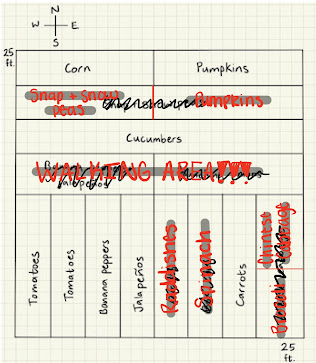
We have touched on a lot of the crops we had planted from the start; however, throughout the year we had two hurricanes which threw a wrench in some of our original plans. Due to the storms coming, on the week we were going to direct seed some of our crops or move them from the green house, we had to wait so that they were not damaged by the weather and this was pushed backed even further when we found out about the second storm. Once the weather had cleared up and we were ready to plant some of our plots or move plants from the greenhouse, a lot of direct seed plants would take too long to grow for us to be able to have a full harvest. Because of all of this, our mapped out plan ended up looking like this: Here are all of the changes we made and why we made them: Snap/snow pea plot cut in half and the other half utilized for pumpkins - the pumpkins started taking over a large majority of the area surrounding our plot so we decided to give them half of this area to grow into to not dis...

Week 8: Post Hurricanes

Image
 After our last post, we were luck enough to be hit with another hurricane.... yay. (This explains the two week break in the blog posts) Coming back after the hurricanes and getting our garden back to the way we wanted it was a huge challenge for us. Due to class schedules and the changing of professors, it took a few weeks to get everything back to an environment that our plants could thrive in. The first thing we noticed after the hurricanes was extremely high weed pressure, especially in our rows that had not yet been planted as well as the need for fertilizer and pest pressure on our plants which were already fruiting. Weed pressure pictured below.  When we were able to have the time as a group to fully complete everything that needed to be done, we got started right away. We began by weeding the areas of the garden that were already planted and completely turned the soil of the areas that were not to ensure there was no longer any remaining disease pressure on our plants....

Week 5: Hurricane Helene!!

Image
When we got out to the plot this Wednesday, it was pretty apparent that the weather was going to get very bad and we needed to prepare for it. We attempted to do all that we could before the weather was unsafe for us to be out there, there were no plant additions, which we initially planned on, to the lot this week because of the weather. Here's what some of our plants looked like before treating or preparing anything (cucumbers and corn). One of the first steps we took for hurricane preparation was putting hay down in a hope that it would create an extra barrier for high wind levels that are projected over the weekend. We only put the hay over our corn and pumpkin plants and are excited to see the difference in protection on these plants vs the others that do not have hay down. The reason we decided not to put hay down on other plants was because they were still so small that the hay would shade them from the sun, not allowing them to reach full growth potential.  Our pumpkins, pi...

Week 3: 9/11/24

Image
Entering the 3rd week of our CSA project! These seedlings are ready to be transplanted! We’ll attempt to minimize transplant shock to make the transition from greenhouse to field less stressful for the plant by verifying maturity, carefully handling the plant (especially its roots), and watering adequately. This week, we’ll be transplanting the tomatoes, pumpkins, and cucumbers, as well as preparing our plot. Our plot previously consisted of beds that ran in only one direction, so we’ll have to change the direction of half the beds so we can get started on one of our management strategy objectives (are there differences in growth in horizontal vs. vertical beds?). We’re walking perpendicular to the beds we want to change the direction of (to create new indents) and filling in the previous indents to switch the orientation of the beds. Plant spacing is necessary to prevent overcrowding and competition for light and resources. Ensuring that there’s adequate space between the plants and t...